

River of Life: A two-day trek through Wadi al-Hasa, one of Jordan’s best hikes
About the Author: Billy Johnson
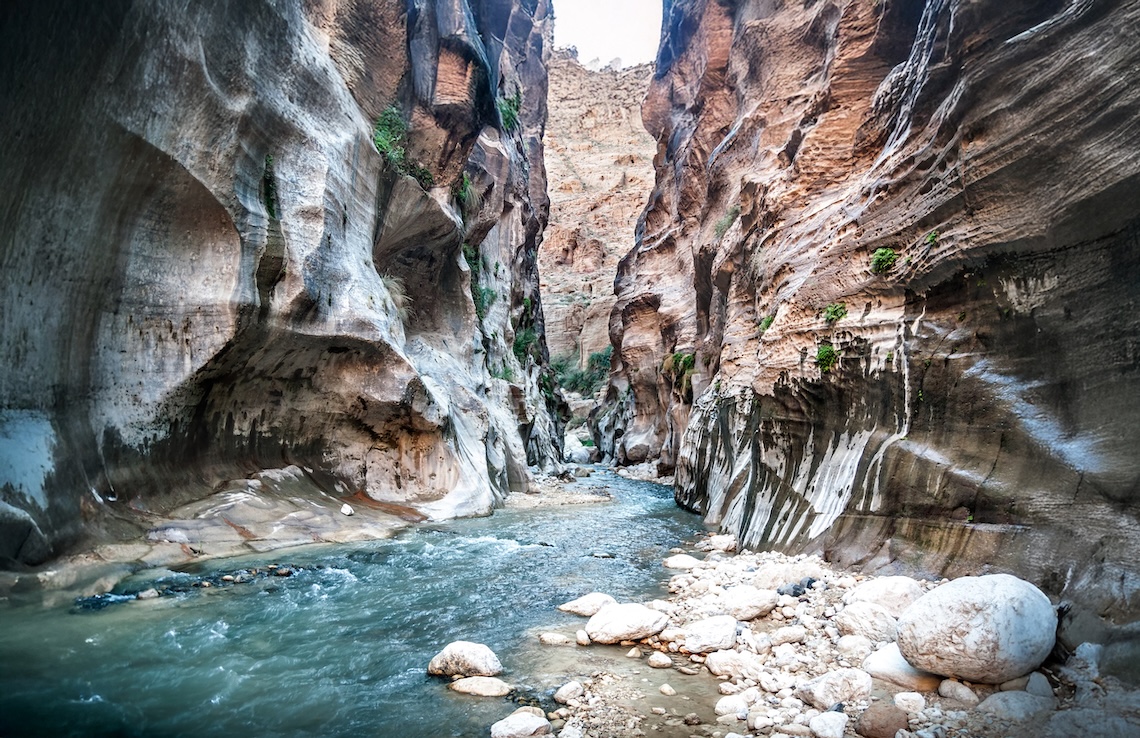
Far from the crowds of Amman, Jordan, Wadi al-Hasa winds its way to the Dead Sea. We head there to discover cool-flowing streams, crab tracks in the sand, and a rhythm of life that few travellers get to experience.
“There’s a snake in there,” Bader, my canyon guide, said, pointing at an inconspicuous hole in the sandstone.
“Um, okay,” I wasn’t sure what to do with the information. Snakes aren’t particularly my forte, and I wasn’t going to be able to do much while it was in the hole.
“I guess we wait.”
I was actually quite glad for the excuse to take off my pack and rest in the shade. The snake had conveniently made its home by a large outcrop and behind some long grass. I put my bag down and perched myself in the sand as Bader walked around the overhang and out of sight; he’s seen enough snakes in his 18 years of guiding.
We were in Wadi al-Hasa, a 25-mile-long canyon that starts near the Jordanian village of Tafilah, a two-hour drive from the capital Amman, and empties into the sugar mills at Gawr as-Safi near the Dead Sea. The first few hours of the hike are relatively exposed, and I wasn’t yet accustomed to Jordan’s May sun.

As I readied my pack next to the tomato and guava farms that marked the beginning of our hike, our driver, Abu Tamara, hurried over and wrapped his hatta – a typical patterned Arabic scarf – around my head and neck. “For the sun,” Bader translated. I was clearly unprepared for the desert with just my cap and Nivea, factor 50 though it was.
The point of our hike was to document the canyon’s elusive wildlife, and having stumbled through the first few miles using all my effort and available limbs to bushwhack through the dense oleander flowers, I was already worried about not achieving what we set out for. We hadn’t seen much besides common birds and probably scared away anything more exciting, so, waiting by the hole, I took my camera out and began trying to capture the fish travelling downstream. I had almost forgotten about the snake when I glanced behind me and jumped out of my skin.
That’s not a snake. A dark, fat, curved limb was poking out the hole. I’m not especially scared of spiders in the UK, but if they make them like this in Jordan, we can add arachnophobia to my list of fears. Suddenly, I wasn’t so worried about taking pictures of the wildlife, but rather surviving it. I grabbed my camera nonetheless and aimed it at the wall. The limb slowly unfurled itself, and more of the creature came into view. Had I disturbed it? Does it want revenge? It carried on creeping towards me when two little eyes popped out. Two dorky little eyes, six legs, and two dark, fat, curved claws.
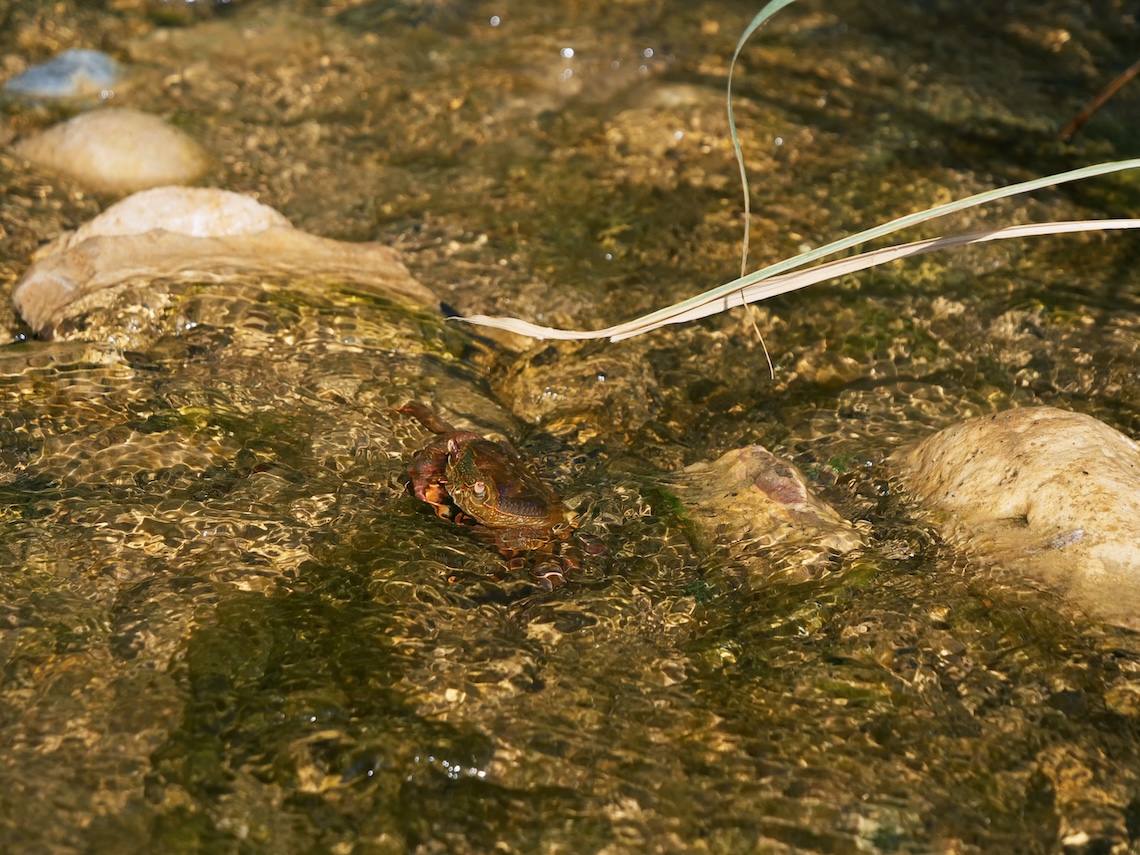
It was a crab. A crab, probably hoping a snack had set up camp outside its home, and undoubtedly disappointed by the loping giant pointing a camera in its face. Kabouraphobia (the phobia of crabs, apparently) isn’t on my list of fears, thankfully for me and it, so I took a few shots and tiptoed around the overhang to tell Bader that I’d seen our first exciting species of the trip. I found him taking a nap on a rock in the sun.
Turning back to go hang out with my new crab friend instead, he had also retreated back into his hole, and I was alone again in the canyon. I sat in the quiet, soaking in the babble of the river and the shuffle of the reeds. I now had confirmation of what I set out to find. The canyon is teeming with life.
Chance Encounters

Canyons are some of the most popular attractions in Jordan, with tourists flocking to Wadi Rum and Wadi Mujib to marvel at the Mars-like landscape and scramble over gigantic, striated boulders. Wadi al-Hasa is less explored but equally beautiful, with open sections filled with wild flowers and hot springs that narrow into a high-walled, otherworldly chasm, the kind you imagine when you think of Jordan. A “canyon canyon,” as I so deftly put it when, out of nowhere, we were walled in.
Before that, though, Wadi al-Hasa is a mosaic of flora, caves, sand banks, and cool flowing streams. You could often hear the caves before you saw them, as the birds make their nests high in the cracks, taking advantage of the ferns growing over the opening. As we wound our way along the river, a massive grotto loomed into view, signalled by this birdsong.
I grabbed my camera and forged ahead before an unexpected sound stopped me in my tracks. There were voices and laughter echoing around the grotto. “Salaam,” Bader called into the darkness, and a casual conversation was quickly struck with a group of locals who were spending their afternoon relaxing in the canyon. They offered us some of the tea they were brewing as well as a dip in the jacuzzi they had fashioned out of a hot spring and some big rocks. I couldn’t follow the Arabic, so I went back to taking pictures of the tens of birds who were also whiling away their afternoon in the cave.
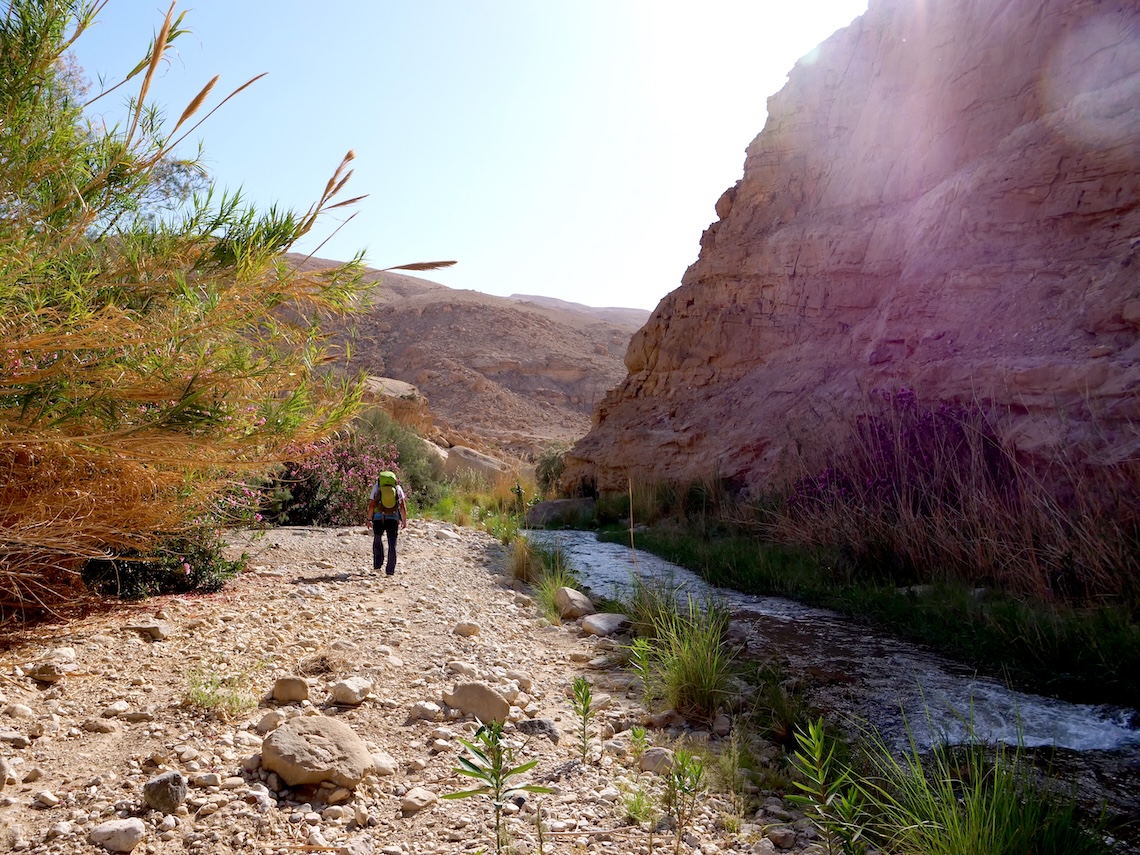
We had a few chance meetings like this on day one, including with a group of farmers who still use the flat canyon floor to transport their flocks through the desert. Just a few hundred metres from the cave, 40 or so goats were doing some much-needed vegetation control, and not long after that, we stumbled across a popular swim spot. We heard the group before we saw them again, which became the norm in the winding corridor of rocks.
We’d made our way above the canyon to cross a dirt road that bisected it. From the deep scar in the earth, voices and laughter once again wafted our way. Following the winding path back down to the riverbed, one of the voices popped his head around the corner and began gesturing enthusiastically for us to follow. We obliged and turned the bend to find five more locals swimming in the pool below a stunning waterfall. The first voice wanted to know why I was carrying a camera, and, more urgently, whether I could take his picture with it, and thus ensued a brief photoshoot, with props (Bader’s sunglasses) and all.
After spending a short while with the group, we made our way back into the main canyon, whose walls were growing steeper by the mile. We wouldn’t see another person for the rest of our hike, but these brief encounters filled the vast expanse of the desert with life.
Mms and Ahs
Leaving our new friends behind, it was then that the scrambling began in earnest. I attempted to photograph yet more crabs, as well as some curious lizards and startled frogs, but eventually the camera had to be put away. With the water at waist height and my sleeping pad thoroughly soaked, I fumbled over boulders and through cracks that Bader seemed to dance past. Granted, he has 18 years of canyoning experience and about seven inches on me, but he was moving with an ease only guides seem to do.
My choice of footwear was also starting to wear on me. “Waterproof shoes are the worst for canyons,” Bader remarked as I pulled on my trusty Helly Hansens. “The water gets in and doesn’t get out.” Sure enough, I spent the rest of the day walking in two increasingly warm puddles. Luckily, once we got to camp and I’d fashioned a clothesline out of some oleander bushes, the beating sun dealt with my wet gear in no time.
Having set up our tents, filtered some water, built a fire and tucked into our dinner of pasta and tinned tomatoes, I began reminiscing about the previous day’s adventures in Amman, Jordan’s capital city. “Make the most of this,” Bader had said dryly as we feasted on falafels, hummus, flat bread, stews, and stuffed aubergine at Sufra on Rainbow Street. “We won’t be eating like this in the canyon.”
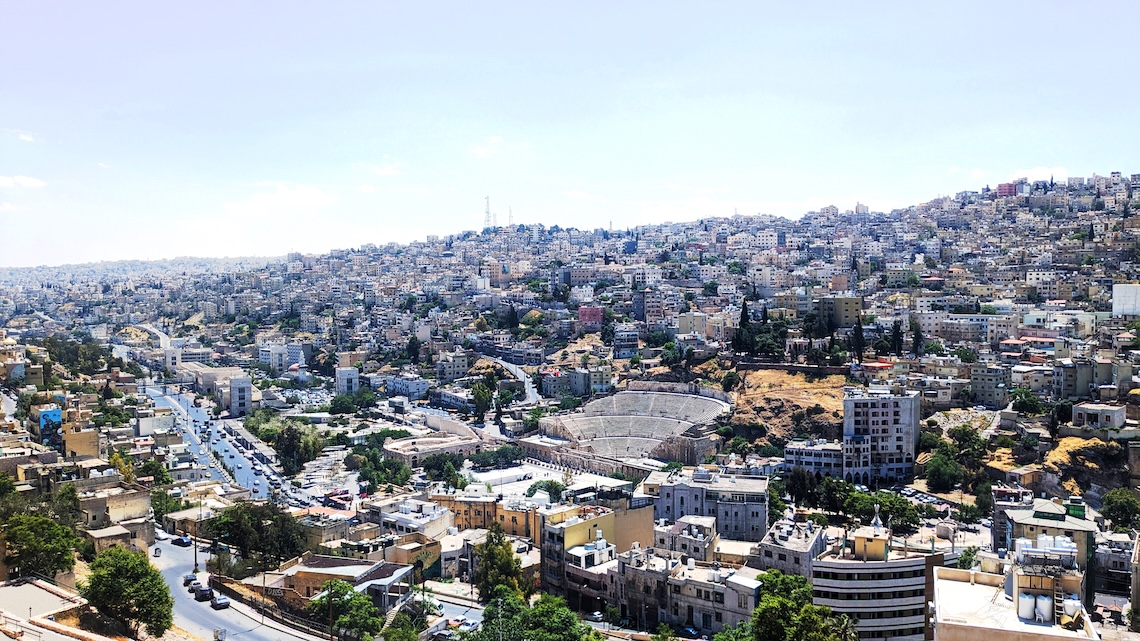
We’d taken an impromptu food tour of Amman, starting with stuffed pastries and manakish, a thyme-covered flatbread, at the Roman amphitheatre, followed by halawet el jibn (mild soft cheese rolled in sweet dough topped with pistachios and syrup) from Slorh Shahba Sweets. Then came knafeh at the ever-popular Habibah Sweets and fresh pomegranate juice from the Paris Square neighbourhood, accompanied every time by a shot of Jordanian coffee – a strong cardamom-infused espresso.
We rounded out the day in Karak, a small city much closer to the canyon’s entrance, with Jordan’s national dish, mansaf. It’s a rice dish with a sharp goat’s yoghurt that the women at Bayt al Jamed al Karaki homestay made from scratch, topped with lamb. It’s traditionally eaten with one hand standing around a large central dish, whilst the other is tucked behind your back. I was told that people often drank the tangy, creamy yoghurt straight from a glass, and I understood why.
Admittedly, I had a modified version of the dish because I haven’t eaten meat in 18 years, but I was there making cartoon-like “mms” and “ahs” nevertheless. “I think if you moved to Jordan, you would start eating meat,” Bader laughed, and for the first time in my life, something to that effect has been said to me, I was inclined to agree.
Bader was right, nothing would ever match the culinary Shangri-La that is Amman, but we’d stocked up pretty well for our hike. I’d laughed when he put eight cartons of hummus in our basket at the supermarket in Amman, but sure enough, it was that and the flat bread I was diving for every time we took a snack break; along with the pistachio halva – a sesame nougat-like delight.
Though we carried plenty of food to see us through our two days in the canyon, Mother Nature, as usual, was equally ready to provide. Bader regularly stopped us to sample some of the flora on offer, including these tiny, tart apple-like fruits, as well as the salty leaves of a small shrub that have helped nomads retain water in the scorching desert for centuries.

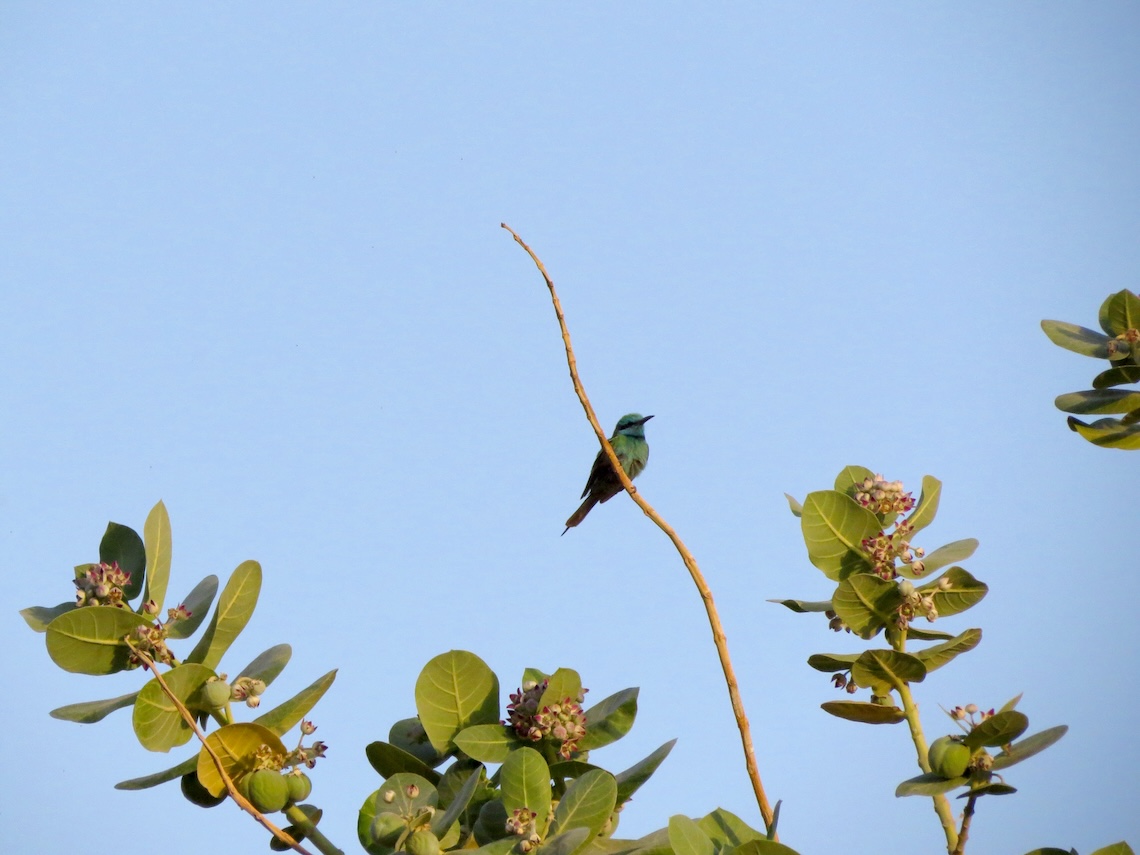
Once we’d finished up dinner, Bader moved higher onto the cliff to see if he could get some signal and check in with his family. Again, alone in the quiet of the canyon, I wandered down to the river. The Asian green bee-eaters, a tiny emerald coloured bird with bright blue heads, were diving for their evening meal, the lizards were out catching flies, and the dragonflies and butterflies were dancing in the fading light.
The eagles we’d seen flying above the camp just a few hours earlier had returned to their perches while the desert foxes and snakes were just starting their day’s business. I sat and let this little world turn around me until the sun went down.
Noise and Colour

We woke early the next day to complete the majority of our walk before the heat grew too intense. It started once again with long grasses and some creative route-setting/scrambling to navigate the hillier sections. The canyon walls grew taller and taller until we were, in fact, in a ‘canyon canyon’.
Stopping for a few hours in a small offshoot where we found a natural pool perfect for swimming, Bader again napped in the sun, a symptom of having three-year-old twins, he told me. I took a dip and gorged on more hummus.
From there, we made the questionable decision to climb rather than walk out of the canyon. This is unorthodox, but the views of the sunset over the river made it worth it. Bader bounced up the cliff, as guides do, while I huffed and puffed behind him. Starting at around 100 metres below sea level, we scaled the cliffs until we were standing in the open desert.
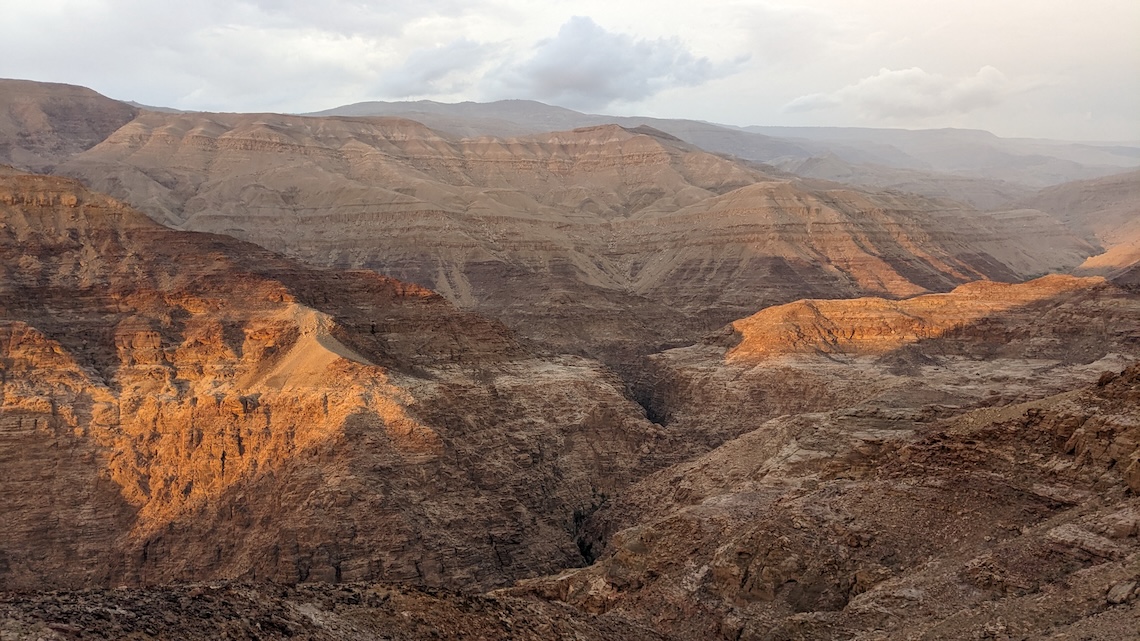
The world was once again a massive expanse of ochre and gold, with Wadi al-Hasa just a sliver of green winding its way towards the sea: small but unmistakably alive. Gazing down from 800 metres above, I thought of the crab and the bee-eaters and the lizards and foxes and dragonflies filling that little world below with noise and colour. What a privilege it was to be a part of, even for just a short time.
Wildlife in the Canyon
It might take a few moments to notice, but Wadi al-Hasa is alive with movement. Keep your eyes on the riverbanks and you’ll spot Jordan’s freshwater crabs, crawling in and out of sandstone holes or creeping across shallow pools. Lizards flash between rocks and desert fox tracks appear in the sand come morning.
Above, the air is full of wings. Asian green bee-eaters dive through the canyon at dusk, joined by dragonflies, butterflies, and the occasional eagle circling high above. Near caves and overhangs, listen for the call of swallows and rock doves nesting in the cool crevices.
Wadi al-Hasa: How to do it
Wadi al-Hasa is one of Jordan’s longest and least-touched canyons, twisting from high near Tafliah to the Dead Sea basin. But that doesn’t mean it’s out of reach. With the right guide and a few days, it’s a deeply rewarding way to experience Jordan’s softer, wilder side.
Getting there
The canyon is a two-and-a-half hour drive south of Amman, Jordan’s capital city. Most treks begin at the upper entrance near the city of Tafilah, where the first section winds past farms and desert villages. You’ll finish near Gawr as-Safi, close to the southern tip of the Dead Sea. Transfers to the start and from the end can be arranged through most guide operators.
How long?
A two-day, one-night trek covers the central stretch of the wadi and includes wild camping, hot springs, river walking, and canyon scrambling. There are longer options too, but two days is the sweet spot for comfort, immersion, and variety.
What’s it like?
Expect to get wet feet. You’ll be wading through riverbeds, climbing over boulders, and you can even swim short sections. It’s not technically difficult, but it does require basic fitness and a sense of adventure. Wild camping means no facilities, so you’ll need to carry in everything you need (and carry it out again).
When to go
Aim for spring or autumn. March to May or late September to November. In summer, the heat can be too much. In winter, flash floods are a risk. Spring brings blooming canyon flora, migrating birds, and cooler water.
What to pack
Quick-dry clothes, a lightweight tent or mat, non-waterproof hiking shoes, and a decent dry bag. A water filter will make it easier to source potable water. You won’t need much, but what you bring should be reliable and able to get wet.
Do you need a guide?
In short: yes. The trail is unmarked, the exits can be hard to find, and water levels shift fast. A local guide will keep you safe, navigate smart routes, and unlock the canyon’s quieter moments, like sharing tea with farmers or spotting the birds you’d otherwise miss.