

Why you need to visit Jungfrau, Switzerland this summer
About the Author: Billy Johnson
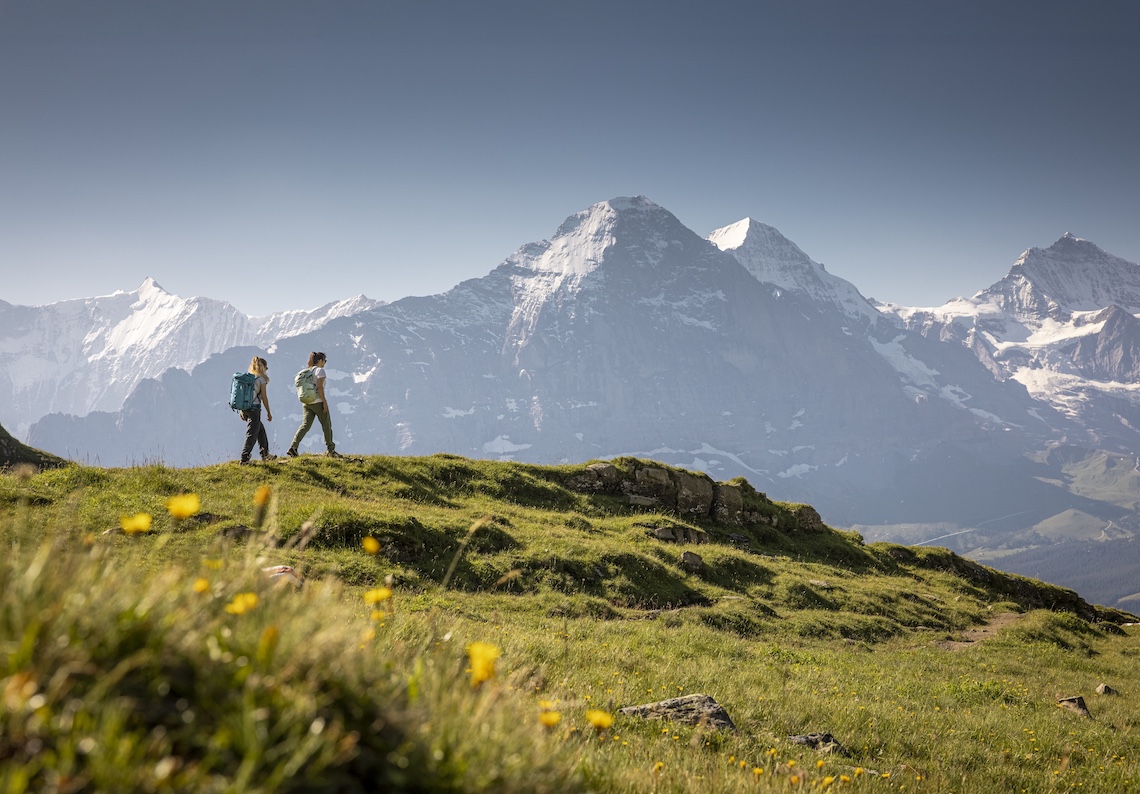
Deep in the Bernese Alps, above the lakeside town of Interlaken, lies the Jungfrau Region, a place defined by three spectacular mountain peaks. The Eiger, with its infamous North Face. The Mönch, standing tall at 4,107m. And the Jungfrau herself, whose snow-covered slopes gleam white at 4,158m above sea level. Together, they form a high-alpine wall that shapes the landscape.
This is Switzerland’s mountain theatre, and the beauty of it is how easily you can step onto the stage. A network of historic cogwheel railways, cable cars, and hiking trails means you don’t need climbing gear to reach the best views.
You can ride the legendary Jungfrau Railway to the ‘Top of Europe’ at 3,485m, walk beside glaciers, or tackle ridge hikes with views that stretch out across neighbouring France and Italy.
With day hikes, long-distance treks, and lift-assisted walks that offer big rewards, there’s a way for everyone and every ability to get out and enjoy the spectacular mountain scenery.
The Jungfrau Region has long stirred imaginations. Tolkien walked here in 1911, and the landscape famously inspired the Elvish refuge of Rivendell in The Lord of the Rings.
With five mountain villages – Grindelwald, Lauterbrunnen, Wengen, Mürren, and Haslital – connected by one of the world’s most efficient transport networks, it’s a region designed for adventure. Whether you’re here for high trails, slow walks, or to breathe the air, everything you need is within reach.
Discover why this part of the Swiss Alps is one of the most rewarding adventure travel destinations in Europe, and how you can experience it yourself.
Hiking in the Jungfrau Region
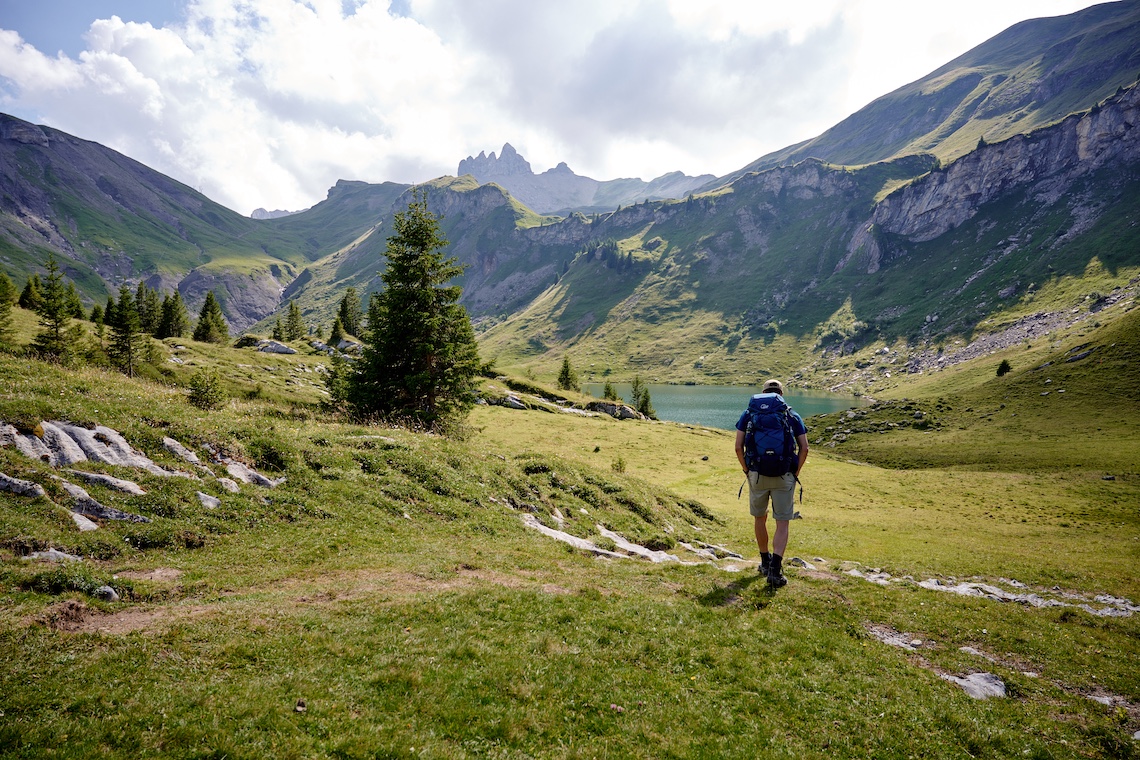
With more than 500km of marked trails, the Jungfrau Region is one of the most walkable high-alpine areas in Europe. From wildflower-lined balcony paths to full-day ridge walks above glaciers, the trail network here is as accessible as it is epic. Trains, funiculars, and cable cars link trailheads to car-free villages and remote mountain plateaus, meaning you don’t have to be a mountaineer to experience world-class scenery on foot.
Whether you’re exploring the Jungfrau Region for a few days or a full week, there’s a trail for you. And thanks to the Swiss transport system’s precision and scope, even the most ambitious routes can be tackled without logistical stress.
The Mürren North Face Trail

Distance: 6km loop
Time to hike: 2-3 hours
Difficulty: Easy
Highlights: Panoramic vistas of the Eiger, Mönch, and Jungfrau peaks
Look out for: Signs about famous alpine climbs and daring mountain rescue stories along the route
Starting and ending in the storybook village of Mürren, this well-marked circuit offers an ideal introduction to high-alpine hiking.
You’ll begin at Allmendhubel funicular station, where a short ride takes you up to a pasture with views that’ll hit you like a steam train: the full, magnificent trio of the Eiger, the Mönch and the Jungfrau rising straight across the Lauterbrunnen Valley.
From there, the trail loops through classic Swiss mountain terrain. Think meadows thick with wildflowers, well-marked paths, rustic wooden mountain chalets and hamlets, and fields of cows and their musical bells.
Along the way, information panels describe the climbing history and geological makeup of the peaks in view, bringing the landscape around you to life.
Towards the end of the walk (if you do it anti-clockwise), you’ll come across a short spur trail that leads to the Spruts waterfall, a pretty waterfall which you can walk behind.
The whole loop is suitable for beginners or families, being well signposted and on well-graded paths and trails, but it has enough open space and altitude to feel like a real mountain walk.
Schynige Platte to First
Distance: 16km
Time to hike: 6 hours
Grade: Moderate to challenging
Highlights: Ridge trail with 350º mountain scenery that’s perfect for photographers
Look out for: Dramatic landscapes from rustic huts to glacial backdrops
If you’re going to do one big day hike in the Jungfrau Region, make it this one. The route from Schynige Platte to First delivers dramatic alpine scenery that’s stitched together by a trail that stays high and scenic for every step.
It’s a point-to-point walk, and most hikers start at Schynige Platte and finish at First, where you can descend by gondola to Grindelwald.
The day begins with a cogwheel train up to Schynige Platte, which sets the tone for what’s to come. At the top, you pass the Alpine Garden, one of Switzerland’s oldest botanical gardens, and home to over 600 native alpine plants, before stepping onto the Loucherhorn ridge.
From here, there are big views in every direction: the Jungfrau massif on one side and the turquoise sweep of Lake Brienz on the other.
The trail rises and falls along the spine of the mountains, traversing karst fields, high meadows, and rocky outcrops as it goes.
Highlights come thick and fast: the remote and beautiful Sägistalsee, the commanding position of the Faulhorn summit inn (built on the top of the Faulhorn in 1830), and the final approach to Bachalpsee, where the Schreckhorn and Wetterhorn are reflected in the lake’s mirror-like water in perfect symmetry.
Despite the distance, there’s no need for scrambling or serious mountaineering kit – just a good level of fitness, decent boots, and a camera. It’s a full day out, but the kind that’s as fun as it is rewarding.
More to Explore…

The best thing about hiking in the Jungfrau Region isn’t just the scenery, it’s the variety. With more than 500km of marked trails, you can tailor each day to your pace, mood, ability, and the weather.
Need something gentle? The Männlichen Panorama Trail is a 90-minute stroll along a broad ridgeline, characterised by incredible views of the Eiger and Lauterbrunnen Valley far below.
Want something more demanding? The Eiger Trail takes you right beneath the mountain’s imposing and infamous North Face, tracing a rocky path through scree fields and alpine pasture. It’s a two-hour descent from Eigergletscher to Alpiglen, but the scale of the rock face above you makes it feel otherworldly.
Craving solitude? Head east to Haslital for quieter routes like the Reichenbach Falls to Rosenlaui trail, which mixes forest walking with gorge views and finishes at one of the prettiest alpine hotels in the region.
Trails between train stations, hut-to-hut treks, and balcony paths thread from one village to another. At every turn, there’s something to stop for, be it a view, a wildflower, a waterfall, or a mountain inn serving apricot tart. It’s hiking done right.
Mystical Gorges
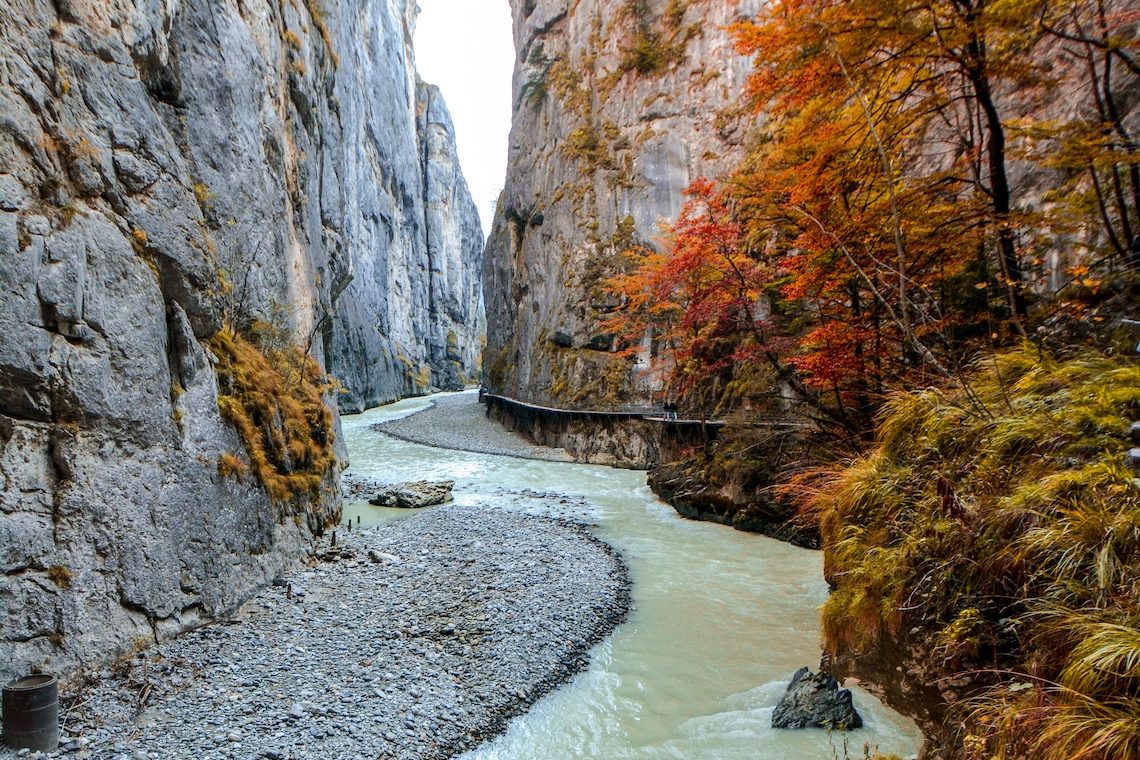
There’s more than one way to explore the Alps. Above the treeline, the Jungfrau Region is all glacier views, jagged ridgelines, and crisp, mountain air. But down in its gorges, everything changes. Light narrows, temperatures fall, and the roar of water takes over
Here, rivers that begin as glacier melt have spent thousands of years carving their way through limestone and marble. The result is a network of deep, narrow chasms where geology, water, and atmosphere collide.
These aren’t just scenic side pieces on a Jungfrau adventure, they’re incredible meetings with the raw forces that have shaped the Bernese Alps.
You don’t need technical gear or mountain legs, just a jacket, a steady step, and a sense of adventure. Whether it’s walking along suspended paths through roaring gorges or stepping onto a net stretched across a ravine, these are experiences that bring you into the landscape in a completely different way.
The Aare Gorge, Meiringen
Distance: 1.4km (one way)
Time to hike: 40 minutes
Difficulty: Easy
Highlights: Dramatic limestone gorge shaped by ancient glacial meltwater
Watch out for: 50m cliffs, turquoise waters, and narrow cliffside tunnels
Just outside Meiringen, the Aare River has carved a narrow slot canyon through the limestone over thousands of years. At its deepest, it drops nearly 200m. At its tightest, it’s barely more than a metre wide. Walk into it, and everything shifts. The light dims, the air cools, and glacial water roars past right beside you.
A 1.4km wooden walkway winds along the gorge wall, passing through short tunnels, and crossing steel bridges suspended above the water. It’s flat and accessible (most visitors complete the main section in under 40 minutes), but the atmosphere is unforgettable.
The narrowest parts of the gorge are fully wheelchair accessible from the western entrance. If you want to make the gorge walk more of a circuit, return via the Lammi Pass hiking trail, which loops back overland to the entrance in about an hour.
Glacier Gorge, Grindelwald

Distance: 1km (one way)
Time to hike: 30-45 minutes
Difficulty: Easy
Highlights: Walk through a dramatic gorge carved by glacial melt over millennia
Look out for: Rushing glacial waters, metal walkways, rock galleries. and the ‘Spiderweb’ net for brave visitors
Where the Lower Grindelwald Glacier once flowed, it carved a gouge in the valley floor that’s now one of the region’s most compelling short walks. Sheer walls rise 300m on either side, marked by glacial polish, folded strata, and gouged marble in shades of pink and green.
You can walk the length of the Glacier Gorge on a series of suspended paths and tunnels, passing pink and green blocks of marble as you feel the cold wind channelled through the ravine.
Below, the glacial waters of the Lütschine River thunder past. Interpretive signs explain the geology and history of the sculpted landscape, pointing out moulins, striations, rock folds, and more.
The highlight of the Glacier Gorge comes in the form of a giant walkable net that’s stretched high across the gorge like a spider’s web. Step out on it, lie down, and look straight into the whitewater below. It’s equal parts thrilling and spectacular.
And if that’s not enough? Just downstream, you can sign up for the Canyon Swing, an 85m free-fall into the gorge itself.
The Alps below the surface

The gorges of the Jungfrau Region offer something very different to the high trails. They’re not about effort, they’re about exploration and immersion. In sound, stone, and scale.
At Trümmelbach Falls, glacier melt pours through ten chasms inside the cliffs of the Lauterbrunnen Valley. Over in Rosenlaui, one of the oldest tourist gorges in the Alps, turquoise meltwater winds through mossy rock crevices. In Aare Gorge, even winter brings a new perspective and on select evenings the path is lit with atmospheric lighting, turning the narrow walkways into a glowing ice-lined corridor. In Grindelwald’s Glacier Gorge, the cold creates a completely different experience as ice formations build on the walls.
Whether it’s the power of the Aare, the ice-carved story of Grindelwald, or the hidden force of Lauterbrunnen’s subterranean streams, the Jungfrau Region’s gorges offer more than cool air and a change of pace. They’re where you get to feel just how long the Alps have been here, and how they’re still being made.
Experience Jungfrau’s culture
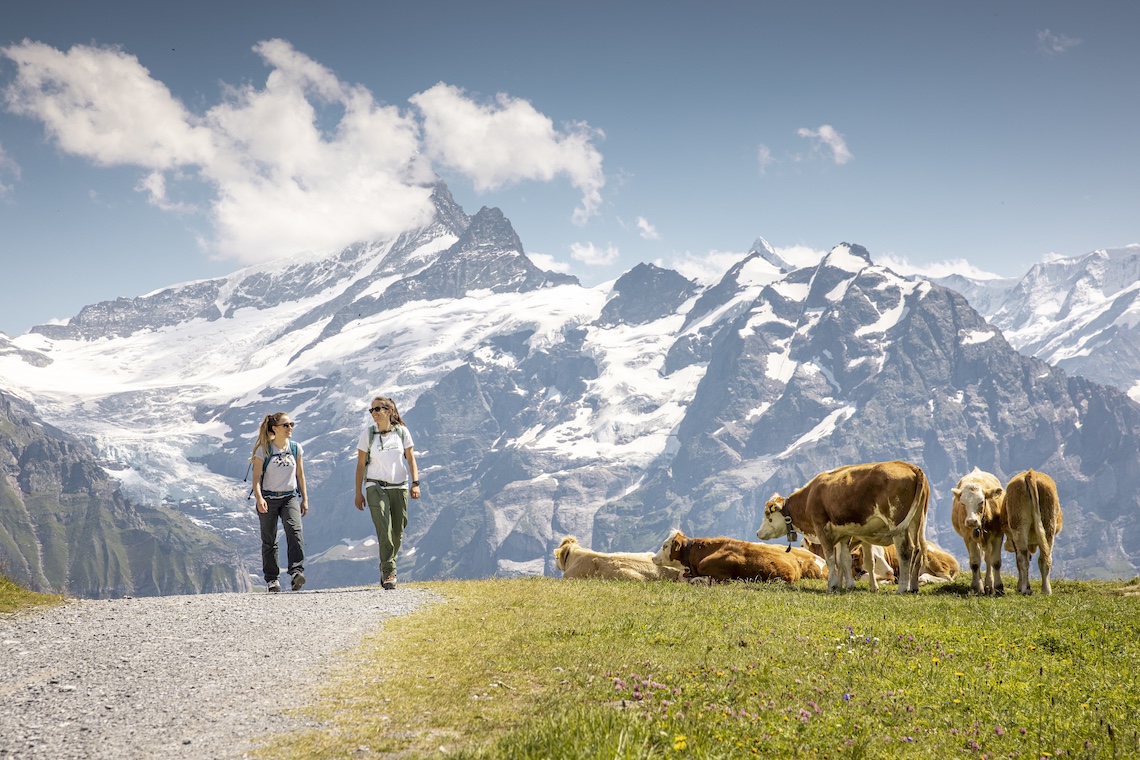
In the Jungfrau Region, adventure isn’t just about getting physical in the outdoors. It’s in the steam of a fondue pot, the echo of an alphorn, and the scent of fresh food drifting from a high alpine hut.
Food and culture are as much a part of the landscape as the mountains themselves, and any trip to the area gives you the perfect opportunity to immerse yourself.
This is a region where traditions aren’t just preserved, they’re practiced. In mountain dairies above Mürren, cheese is still made the way it was a century ago. In village kitchens, recipes follow the seasons.
And in restaurants from Wengen to Grindelwald, chefs find bold new ways to serve the flavours of the Alps, whether it’s a rustic rösti or a multi-course tasting menu made from mountain herbs and local produce.
But it’s not just about what’s on the plate. It’s the view from the table. The way locals celebrate the return of spring with flower garlands and folk music. The joy of eating a farmer’s breakfast after watching a wheel of cheese take shape by hand. It’s food and tradition rooted in place. And it’s all there to savour.
Alpine Craft in Action

Get there: 1-hour hike from Mürren
What is it: Guided cultural walk and mountain breakfast
Best for: Traditional craft, food, and views
High above Mürren, at nearly 2,000m, the Schiltalp alpine dairy still does things the old way. Each summer, cows are led to graze in pastures filled with wildflowers, and a few lucky visitors hike up early enough to see cheesemaking in progress.
Here, warm milk is ladled into copper cauldrons over wood fires, stirred by hand, and aged on wooden shelves. The result? Bold, earthy Alpkäse, often served with crusty rye bread and hot coffee.
The dairy sits at 1,946m, and reaching it is part of the experience. It’s a steady hour-long walk from Mürren through pine forest and open pasture to the Gimmelen plateau, followed by a final ascent to the dairy’s wooden hut. Morning tours run throughout the summer, culminating in a mountain breakfast on benches overlooking the peaks. Prices start from CHF 20 for adults.
Gourmet Dining in Grindelwald

Location: Central Grindelwald
Best for: Haute cuisine with alpine soul
Awards: 4 restaurants with 15+ GaultMillau points
Grindelwald has quietly become one of the Alps’ top food destinations – a gourmet village where chefs pair fine dining with local identity. Four restaurants hold 15 or more GaultMillau points, and one boasts a Michelin star.
At Glacier Fine Dining, seasonal tasting menus are crafted with alpine ingredients and finesse. 1910 Gourmet by Hausers offers elegant vegetable-led dishes with mountain flair. At BG’s Grill, wood-fired meats and soul food are served in a warm, modern setting. And Fiescherblick blends French techniques with Nordic simplicity.
These kitchens celebrate both heritage and innovation, turning traditional dishes into something fresh, local, and delicious. For something more casual, Barry’s, BaseCamp, and the Fondue Stübli offer rustic charm and big flavour.
More to explore

From open-air concerts to traditional parades, Grindelwald’s village streets come alive throughout the year with a series of local festivals blending music, culture, and mountain hospitality.
Arguably the most scenic marathon in the world, this iconic race climbs from Interlaken to the foot of the Eiger, with thousands of runners battling their way into the heart of the Bernese Alps.
Spy World and 360-degree Dining
Atop the Schilthorn, experience the James Bond museum, revolving restaurant with world-class views of the surrounding mountains, and the new steepest cable car in the world.